
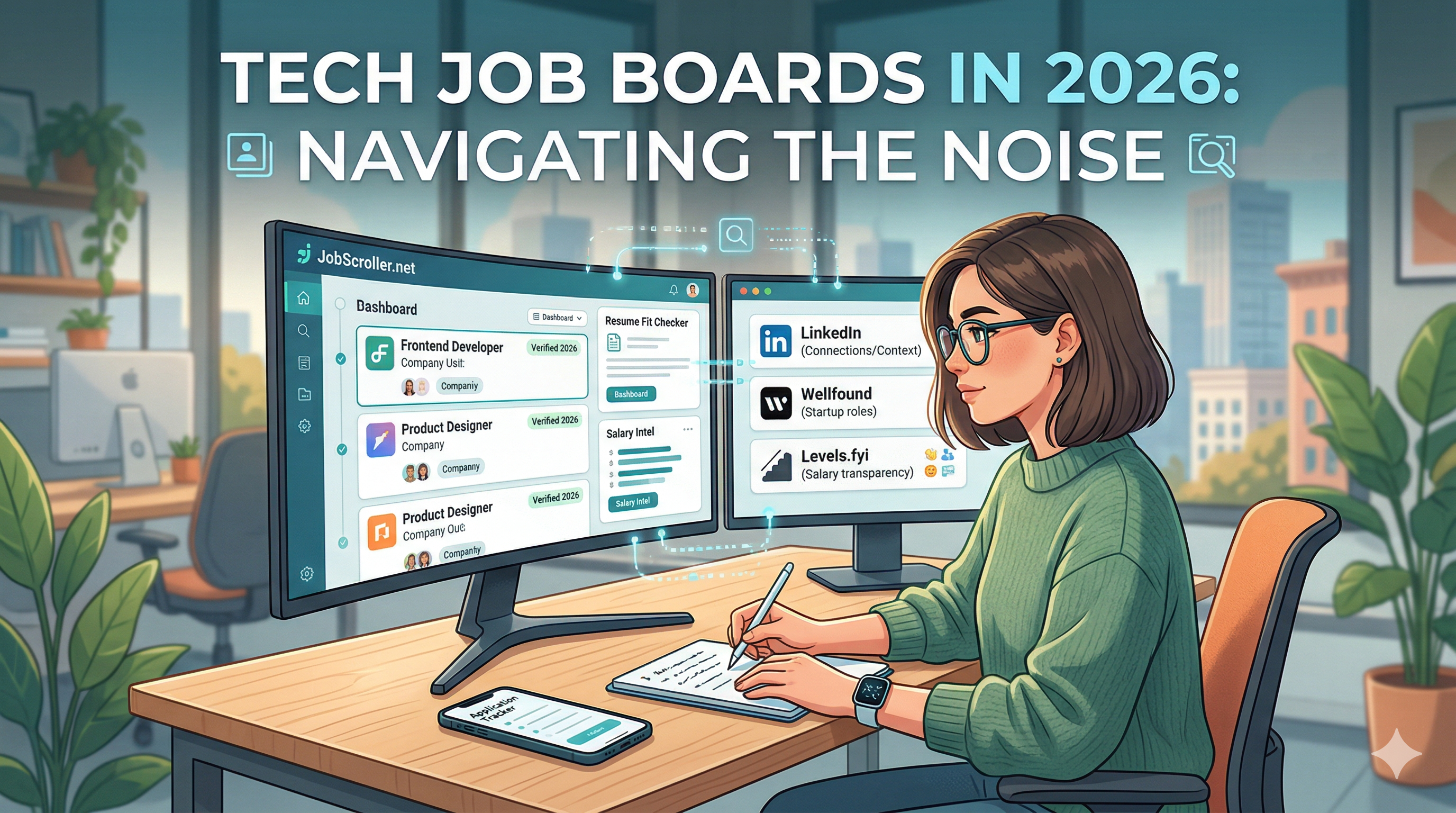
Not all job boards are created equal—especially in tech. Some are bloated with recruiter spam, some are hidden behind paywalls, and some are genuinely useful. After spending way too much time on all of them, here is an honest breakdown of what’s actually worth your time in 2026.
1. JobScroller: The Modern Default
The newcomer that’s quietly become the industry’s starting point. JobScroller crawls over 1,300 company career pages directly (Greenhouse, Lever, Ashby, Workday, etc.) and aggregates them into one clean search.
- The Pro: No recruiter postings or agency listings. It’s just real jobs from real companies.
- The X-Factor: It includes a free resume fit checker for keyword analysis and a salary intelligence page built from live postings.
- The Weakness: Some enterprise companies with aggressive anti-scraping measures have thin descriptions.
https://www.jobscroller.net/
2. LinkedIn: Still the Network, Not Always the Board
LinkedIn is essential, but the search experience is noisy. You’ll wade through “ghost jobs” and roles that have been open for eight months.
- Best Use Case: Use it for context. See who works there, check for mutual connections, and research the team hierarchy.
- Pro Tip: Use “Easy Apply” sparingly; it’s often a black hole.
linkedin.com
3. Glassdoor: Research First, Hunting Second
Glassdoor remains the gold standard for salary data and interview reviews, but its job board is unremarkable.
- The Caveat: Reviews skew toward extremes (love or hate). Take the 3.5-star ratings with a grain of salt and look for patterns in the “Cons.”
https://www.glassdoor.com/
4. Wellfound (formerly AngelList Talent)
If you want to work at a Series A or B startup, Wellfound has no real competition.
- Why it works: Listings typically include equity ranges, salary bands, and direct contact with founders.
- The Limitation: It’s thin on enterprise or “Big Tech” roles.
https://wellfound.com/
5. Levels.fyi: For the Comp-Driven Search
Originally a salary database, it has evolved into a high-transparency job board. Every listing shows total compensation: Base + Bonus + Equity.
- Best For: Mid-to-senior roles at FAANG-adjacent companies where compensation structure is complex.
https://www.levels.fyi/
6. Otta (by Welcome to the Jungle)
If Hired was the king of the 2010s, Otta is the king of the 2020s. It’s highly curated and specifically designed for “modern” tech companies.
- The Pro: Their matching algorithm is genuinely smart. It filters out “legacy” corporate roles and only shows you companies with modern tech stacks and transparent cultures.
- The X-Factor: It gives you a “relevance score” for every job, so you don’t waste time on roles that aren’t a fit.
- The Weakness: Like Wellfound, it leans heavily into startups and mid-market tech; you won’t find many government or massive enterprise roles here.
https://us.welcometothejungle.com/
7. Dice: The Enterprise Workhorse
The interface feels like 1998, but the volume for legacy tech (Java, .NET, Infrastructure) is unmatched.
- Best For: Stable roles in government contracting or massive financial institutions.
https://www.dice.com/
8. Y Combinator (Work at a Startup)
Narrow but elite. These roles are exclusively at YC-backed companies.
- The Draw: High quality bar, meaningful equity, and vetted leadership.
https://www.ycombinator.com/
9. Indeed: The Last Resort
Indeed has the highest volume but the highest noise. Expect duplicate listings and outdated postings. Use it only for very niche geographic searches.
https://www.indeed.com/
10. Built In: The Culture-First Choice
If you care about where you work as much as what you do, Built In is the move. It’s less of a raw data dump and more of a digital magazine for tech hubs.
The Weakness: It can feel a bit like a PR machine since companies pay for the polished profiles, so you’ll want to cross-reference with Glassdoor.
The Pro: Excellent for researching company “vibes,” benefits, and DEI initiatives. Their “Best Places to Work” lists are highly regarded in the industry.
The X-Factor: Great for finding remote-first roles or deep-diving into specific tech hubs like Austin, NYC, or San Francisco.
https://builtin.com/
2026 Tech Job Board Comparison
| Board | Best For | Noise Level |
| JobScroller | Clean tech search & free tools | Very Low |
| Networking & Research | High | |
| Wellfound | Early-stage Startups | Low |
| Levels.fyi | Compensation Transparency | Low |
| Dice | Enterprise & Legacy Tech | Medium |
| Otta | Passive Search (Senior) | Low |
| Built In | Company Culture & Hubs | Low |
The 2026 Strategy
The move this year is to use a “Triple Threat” approach rather than relying on one site:
- JobScroller for daily fresh listings and keyword optimization.
- Wellfound if you are specifically targeting the startup ecosystem.
- LinkedIn to find a warm intro once you’ve found a role you like.
Everything else is situational. Happy hunting!



Leave a Reply